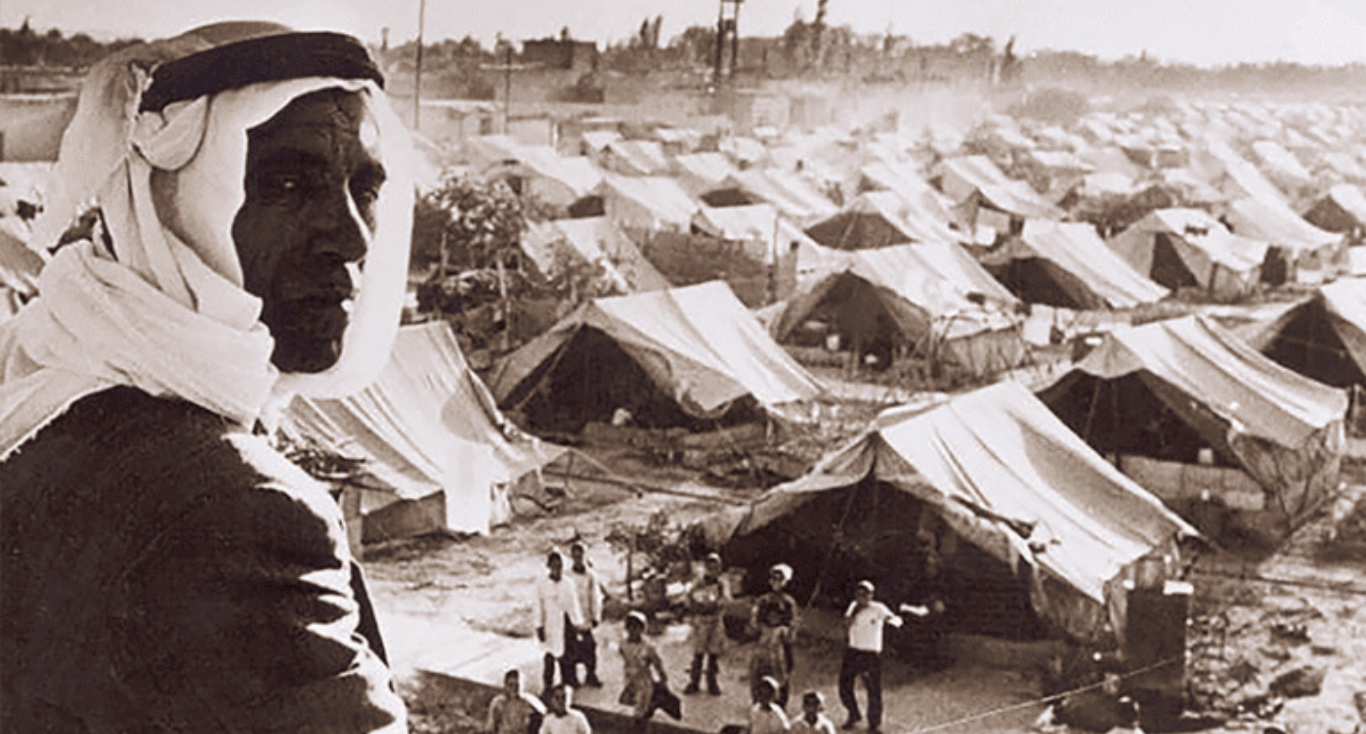
What the ongoing colonial dispossession of our people says about the international liberal order then and now.
The Post–World War II Global Order: Built by and for Empire
For much of the Western world, the years following World War II are remembered as the birth of the United Nations, the Universal Declaration of Human Rights, and the Nuremberg Trials. But for the Global Majority, 1945–1948 marked the continuation and restructuring of imperial domination.
Western colonial powers drafted a multilateral legal system and human rights frameworks while waging genocide, ethnic cleansing, and occupation across Palestine, Algeria, Congo (now Democratic Republic of the Congo), India, and beyond.
The intention was clear: to build an international legal system that would preserve imperialism. The Fourth Geneva Convention (1949) was designed to regulate colonial violence rather than end it. Meanwhile, the Universal Declaration of Human Rights (1948), drafted mainly by European and North American intellectuals, centered individual rights while sidelining collective rights central to anti-colonial struggles: self-determination, sovereignty, liberation, land restitution, and economic justice.
Thus, the catastrophes of those years were not anomalies but a direct result of imperial impunity, silenced and distorted by the dominant historical narrative.
1948: Formalizing the Apartheid Regime in South Africa
The National Party, the political vehicle of the European settler population, divided and restricted access to urban areas by race, leading to the violent expulsion of thousands of Coloureds, Blacks, and Indians, and the creation of the Bantustans. It also regulated social interactions, such as banning mixed-race marriages, and controlled access to social services like education.
1947–1948: The India-Pakistan Partition
The UK ended its colonial regime in haste, unfolding a violent process with total impunity. Fifteen million people were uprooted and two million people killed. Some British soldiers and journalists who had witnessed the Nazi death camps reported that the Partition’s brutalities were worse, yet they remained largely unaddressed. To this day, that horrific tragedy is not well-known beyond South Asia.
1947–1948: Palestine’s Partition and the Nakba
Following the partition of Palestine, driven by European colonial support for the Zionist project and validated by the then-UN Member States, Zionist forces launched an offensive on Palestine.
Zionist brigades conducted more than 70 atrocious massacres and razed more than 500 villages and towns to the ground. They killed an estimated 15,000 Palestinians.
800,000 Palestinians were forcibly displaced from their land, with no possibility of return to this day.
Approximately 4,244,776 acres of Palestinian land were stolen at that time.
Approximately 70,000 Palestinian books were systematically looted, then mostly destroyed.
The US-Zionist Alliance
While the Nakba in Palestine and the Partition between India and Pakistan both marked an exit strategy for a crumbling British Empire that was never held accountable, Zionist colonialism became Washington’s proxy in Southwest Asia.
The US seized this opportunity to advance its hegemony in the region, securing oil routes, containing Soviet influence, and creating a military outpost. The US became Israel’s primary patron, providing unconditional military and diplomatic support that turned the UN Security Council into a tool for enabling domination.
This alliance demonstrated how imperial power relies on maintaining colonial dependencies: Israel could not exist as an occupying power without US backing, and US hegemony needed Israel as its enforcer in the region.
The Current Shattering: Double Standards Exposed
Israel’s genocidal tactics in Gaza (dubbed “the Gaza Doctrine” and deployed also in Lebanon) have exposed the blatant double standards and flaws of dominant multilateral institutions, international law, and human rights frameworks. These bodies have proven incapable of stopping such crimes and actors; instead, they have become complicit.
Imperial nuclear threats have also revealed the inadequacy of anti-proliferation treaties: Iran is bombed, sanctioned, and blockaded despite having no nuclear weapons, while the only regime in the region with undeclared nuclear weapons (the Israeli regime) perpetuates unchecked violence.
This reveals the current world order’s core contradiction: it claims to be based on rules but actually operates through domination and partiality.
This Moment of Reckoning and Shifting
The past catastrophes, including the Nakba that we commemorate this week, still strongly shape the present and future of the peoples they affected.
Across the Global Majority, people and governments increasingly recognize the post Second-World war international system not as a guarantor of justice, but as a structure that has failed to dismantle colonial domination, racial hierarchy, and economic exploitation. Gaza has been at the center of that realization.
Pockets of resistance are emerging in countries still facing the aftermath of colonial exploitation and also in the West, where representatives of former colonies or descendants of oppressed people are reclaiming their belonging and agency. From protests in Bangladesh and Nepal, to student encampments in South Africa, and demonstrations against the Israeli genocide from London to New York, the resistance against colonial and post-colonial oppression is growing.
Global Majority governments are challenging the status quo more explicitly and have begun organizing alternative diplomatic spheres (BRICS, Shanghai Cooperation Organization, The Hague Group, etc.) away from Western-centric lenses and practices.
It is up to us to continue redefining those parameters to ensure they are based on justice and dignity.